

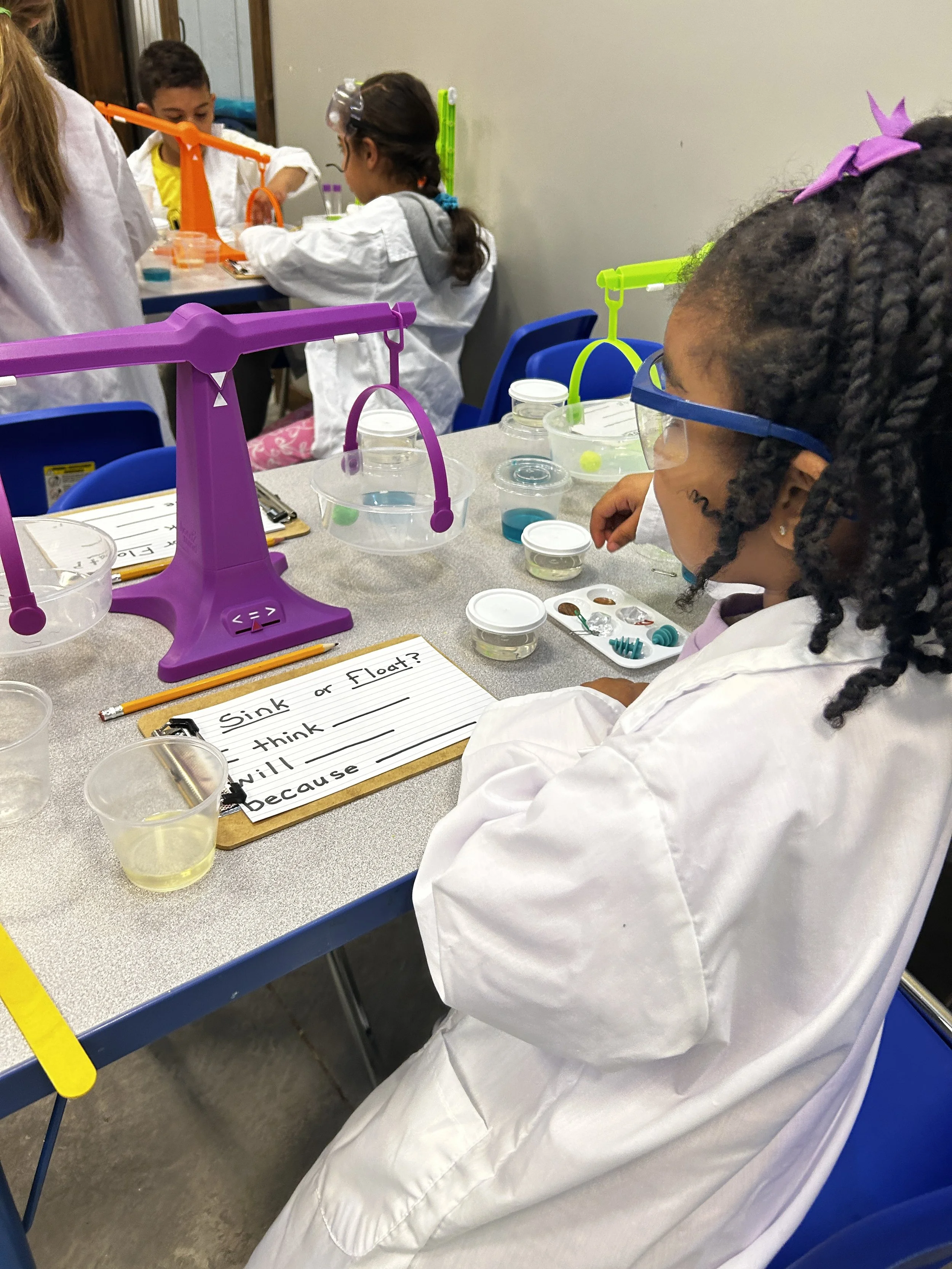
Ms. Kizzle’s Science Lab is a hands-on, curiosity-driven science experience designed for children who learn best by doing, asking, testing, and trying again. Each session invites students into real scientific exploration—where experiments aren’t just watched, they’re built, tested, adjusted, and discussed.
Led by Ms. Kizzle, the lab blends foundational science concepts with playful investigation. Students explore topics across chemistry, biology, physics, earth science, and engineering, all through age-appropriate experiments that spark confidence and independent thinking.
This is not a worksheet-based class.
This is a thinking lab.
What Makes Ms. Kizzle’s Science Lab Different
Hands-on first: Every session centers on active experimentation and problem-solving
Curiosity-led learning: Questions are welcomed, explored, and tested—not rushed
Real tools & real materials: Kids work with safe, authentic lab materials
Confidence-building: Trial, error, and revision are part of the process
Inclusive & engaging: Designed for a wide range of learning styles and thinkers
What Students Experience
Live demonstrations that turn into student-led experiments
Guided discovery that encourages observation, prediction, and reflection
Opportunities to collaborate, test ideas, and explain results
A learning environment where it’s safe to be curious—and bold enough to be wrong
SATURDAY SCIENCE LAB
We meet Most Saturdays
Always Call or Check Social Media for Accurate Hours
-
For older students, the lab shifts toward active problem-solving and early scientific reasoning. Children begin making predictions, testing ideas, adjusting experiments, and explaining what they observe—all while working with real materials and real questions.
What Ages 5–9 Experience
Hands-on experiments across chemistry, biology, physics, and engineering
Guided inquiry that encourages prediction, testing, and revision
Collaboration with peers to solve challenges and compare results
Introduction to scientific tools, lab safety, and process thinking
A learning environment where mistakes are part of discovery
This age group begins to understand that science isn’t about having the right answer—it’s about thinking like a scientist.